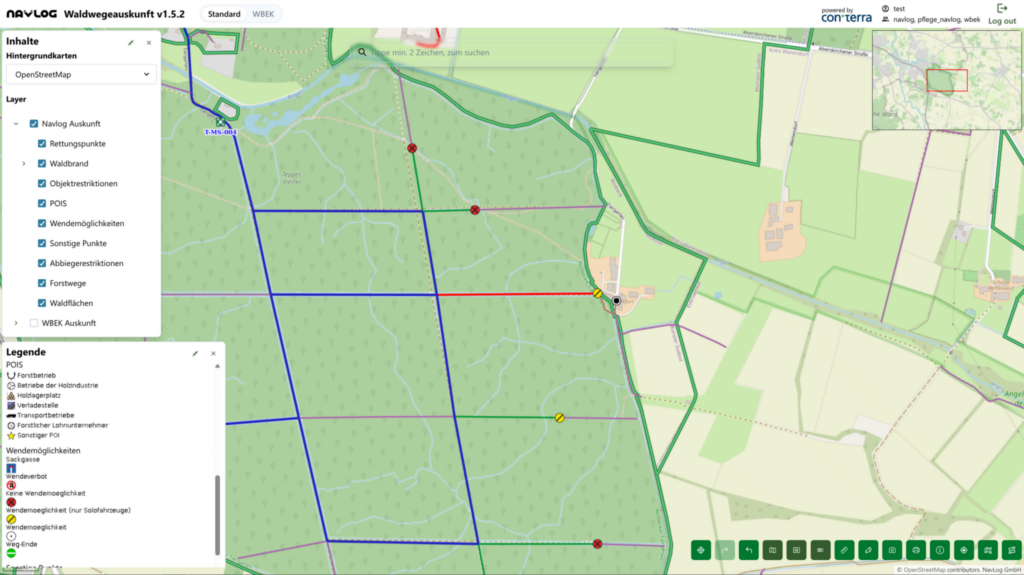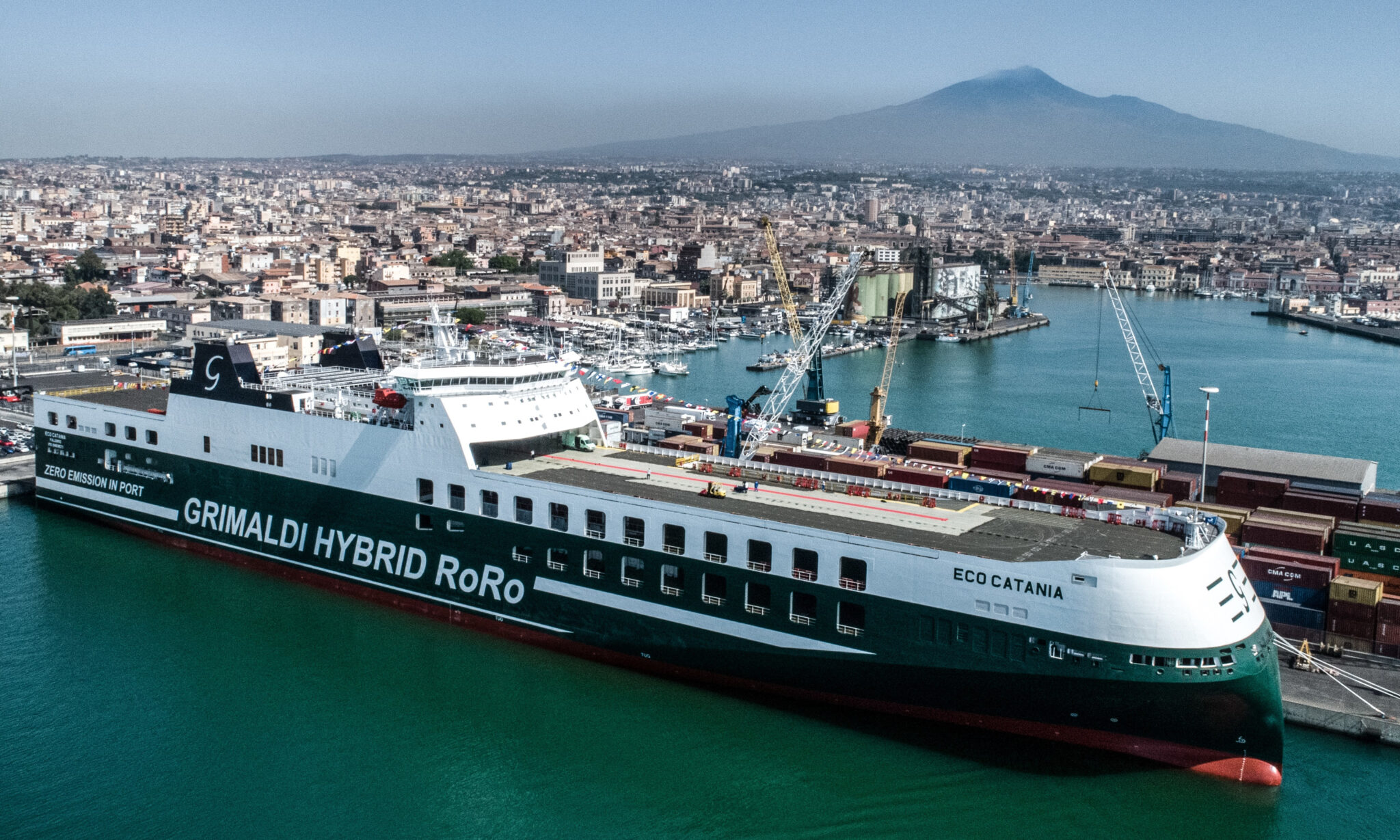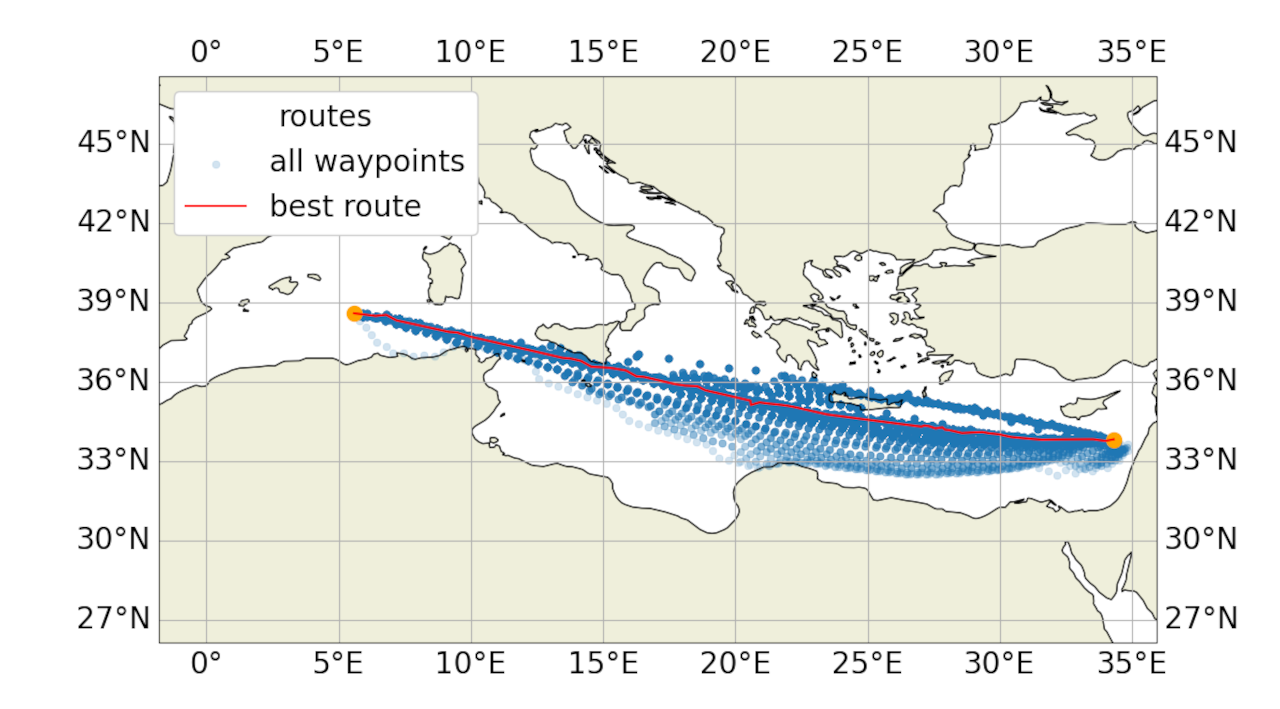
The Weather Routing Tool (WRT) is an open-source Python library developed by 52°North for calculating optimal maritime routes. Its development began under the MariData project (funded by BMWE) and is currently continuing as part of the EU TwinShip project. WRT’s primary objective is to minimize fuel consumption in the shipping industry by using environmental data to help route vessels. This data includes various meteorological parameters, such as wind and wave conditions, as well as water depth information.
Volkswagen GeoNet Analysis
Analytics for Driving Automation Systems Service Areas
The analysis toolbox will help Volkswagen Commercial Vehicles provide data for their Automated Driving Systems.
The Operational Design Domain describes the conditions under which a driving automation system is designed to operate. This includes environmental and geographic information as well as the required presence or absence of certain traffic or roadway characteristics. At Volkswagen Commercial Vehicles, a dedicated team defines such boundary conditions for the development and testing process. This allows the team to evaluate potential service areas for Mobility as a Service applications. Based on our expertise in geospatial data analysis and efficient processing of large volumes of geodata, Volkswagen Commercial Vehicles contracted 52°North to develop a toolbox that enables the automatic derivation of these characteristics from available spatial datasets. Based on these characteristics, an annotated topological road network is generated that allows routing according to specific conditions.
The content-rich road network data provided by Open Street Map builds the foundation for the analysis toolbox. It enables the derivation of basic properties, such as the distribution of road types and street furniture, speed limits or number of lanes for a given area of interest. The toolbox also supports complex analysis capabilities, such as statistics on curve radius, the intersection impact angle, or intersection complexity. The system combines multiple analysis concepts:
- Basic analysis using the Python library osmnx
- Complex statistics using osmnx in combination with a PostGIS database
- Enrichment with third-party data sets (e.g. traffic signs)
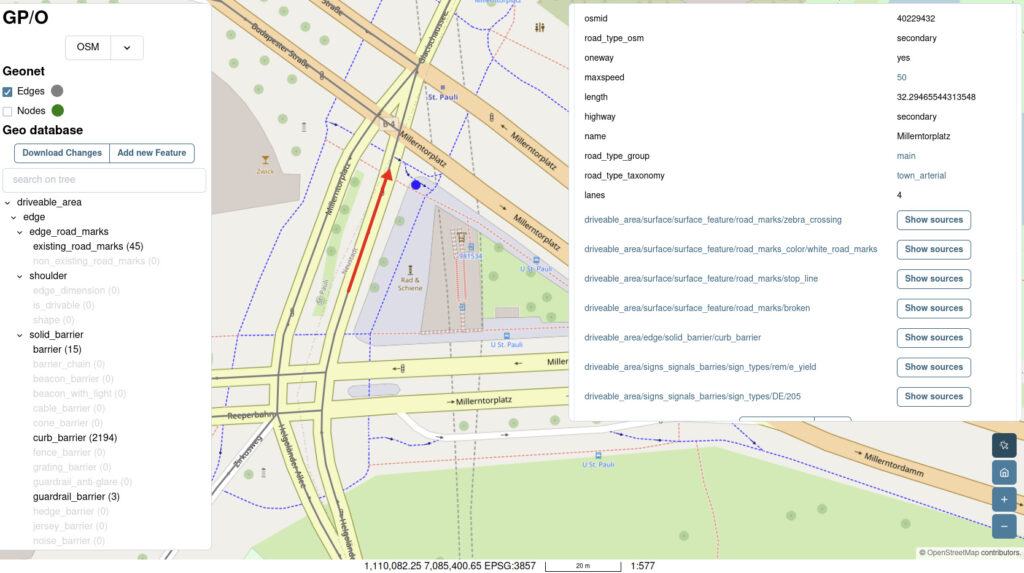
During 2024, the team focused on creating the annotated topological road network, the “GeoNet”. A broad range of parameters from the Operational Design Domain taxonomy were used in the annotation process. This included the previously developed complex analysis features, such as curve radius or visibility range. In addition, we developed a visualization component based on the Open Pioneer Trails framework to provide a sophisticated rendering of the generated GeoNet.

Customer
Volkswagen Commercial Vehicles ADMT, Germany
Atrai Bikes
Riding with the senseBox:bike in a Data-Driven Bicycle City
Transforming bike commuting by providing real-time data insights
The Atrai Bikes project aims to support urban planning by involving citizens, businesses and local governments in the systematic collection and analysis of bicycle infrastructure data. The two-year project, funded by the German Federal Ministry of Education and Research (BMBF) and the São Paulo Research Foundation, FAPESP in Brazil, is a joint effort of three organizations: re:edu and 52°North in Münster, Germany, and the Cordial Institute in São Paulo, Brazil.
A key component of the project’s objectives is the integration of hardware technology from the open source senseBox:bike project, which is seamlessly connected to a dedicated app and a web-based analysis platform. This infrastructure enables the effortless collection of important data during daily bike rides and provides insights into parameters such as distance to car traffic, vibration levels, temperature fluctuations and particulate matter concentrations. These insights are invaluable to various stakeholders and provide a comprehensive understanding of the urban cycling experience.
The data collected is carefully stored and visualized using the openSenseMap solution, an open data platform enhanced with a web-based analysis component with GeoAI tools. This technology not only enables cyclists to make informed decisions about their routes, but also allows businesses to optimize logistics and governments to improve cycling infrastructure and understand cycling flows.
A robust citizen science approach complements this technological innovation. Workshops will be held in both Münster and São Paulo to engage participants, deepen their connection to the project and strengthen their skills and motivation. This joint effort promises not only to enrich the user experience, but also to advance the sophistication of the software analyses, bringing significant advances to urban cycling environments.

Partners
Reedu GmbH & Co. KG , Germany
Instituto Cordial, Brazil
Volkswagen Commercial Vehicles Map Data Analysis
Data Analysis for Automated Driving
The analysis toolbox will help Volkswagen Commercial Vehicles provide data for their Automated Driving Systems.
The Operational Design Domain describes the constraints under which a driving automation system is designed to operate. This includes environmental and geographic information as well as the required presence or absence of certain traffic or roadway characteristics. At Volkswagen Commercial Vehicles, a dedicated team defines such boundary conditions for the development and testing process. This allows the team to evaluate potential service areas for Mobility as a Service applications. Based on our expertise in geospatial data analysis and efficient processing of large volumes of geodata, Volkswagen Commercial Vehicles contracted 52°North to develop a toolbox that enables the automatic derivation of these characteristics from available spatial datasets.
The content-rich road network data provided by Open Street Map builds the foundation for the analysis toolbox. It enables the derivation of basic properties such as the distribution of road types and street fruniture, speed limits or number of lanes for a given area of interest. The toolbox will also support complex analysis capabilities, such as statistics on curve radius, the intersection impact angle, or intersection complexity. The system combines two different analysis concepts:
- Basic analysis using the Overpass Turbo API
- Complex statistics using the Python library osmnx in combination with a PostGIS database
During 2023, the team focused on more complex analysis. Important parameters such as the visibility range of certain roads, the incident angle of roads meeting at an intersection, or the minimum curve radius were derived. Our team integrated all analysis features into one executable toolbox. It can be used from the command line, but is already prepared to run as a service in a larger deployment environment.

Customer
Volkswagen Commercial Vehicles, Germany