
Co-Design to Reveal the Value of Climate Services
I-CISK empowers local communities to build and use tailored local Climate Services to adapt to climate change.
Climate Services (CS) are crucial to empowering citizens, stakeholders and decision-makers in defining resilient pathways to adapt to climate change and extreme events. Despite advances in scientific data and knowledge (e.g., Copernicus, GEOSS), current CS fail to achieve their full value proposition to end users. Challenges include incorporation of social and behavioral factors, local needs, knowledge and the customs of end users. I-CISK developed a next generation of end-user CS, which followed a socially and behaviorally informed approach to co-creating services that met climate information needs at a relevant spatial and temporal scale. It took a trans-disciplinary approach to developing CS by working with stakeholders in seven Living Labs established in climate hotspots in Europe, it’s neighbors, and Africa, to address climate change and extremes (droughts, floods and heatwaves) faced by agriculture, forestry, tourism, energy, health, and the humanitarian sectors. Together with end users, I-CISK co-designed, co-created, co-implemented, and co-evaluated pre-operational CS that provide a change in integrating local knowledge, perceptions and preferences with scientific knowledge. This co-creation framework is unique as it
- links climate impact and adaptation at different temporal scales from (sub)-seasonal forecasts to climate-scale projections, and
- explicitly considers the feedback between human behavior and climate, i.e., between adaptation strategies and options, in a multi-timescale, multi-sector, and multi-hazard setting.
The novel CS were built on a highly customizable cloud-based web platform that I-CISK developed; freely available, and easily replicable. The I-CISK co-creation framework, supported by online open courses, guidelines, business stories and strategic dissemination, catalyzes the production and adoption of CS that combine end user’s local knowledge with scientific knowledge, contributes to improved decisions and policies, and a flourishing market for end-user CS.
In 2025, 52°North completed the integration of stakeholder requirements identified during the co-design process. Based on these findings, our team fully implemented the CS for the Living Labs Rijnland (NL) and Guadalquivir (ES). The CS use Open Pioneer, a React-based framework developed by con terra GmbH and 52°North.
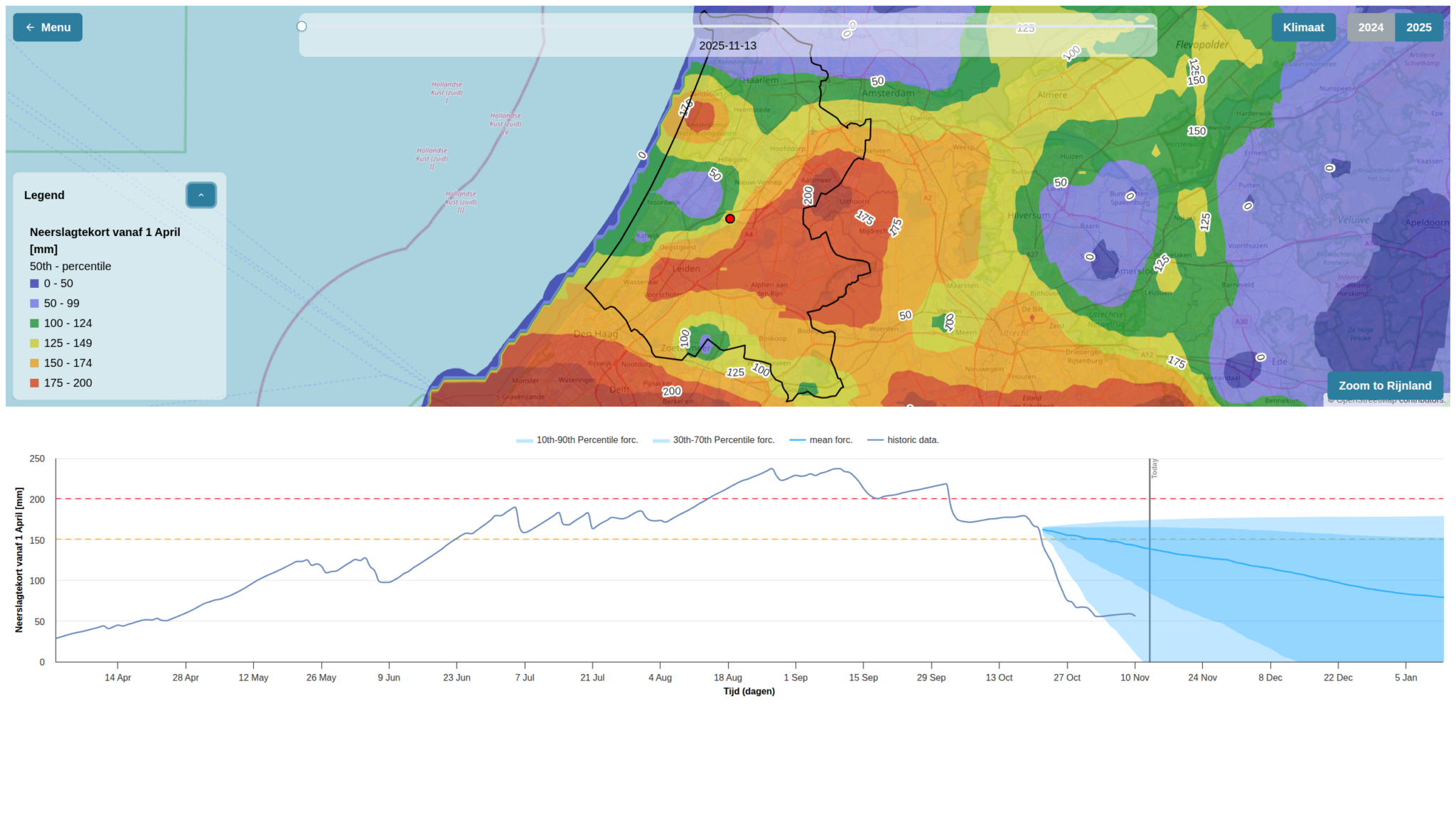
The Rijnland LL CS provides tailored, localized information for different user groups. For seasonal planning, it supports the water board with detailed runoff predictions for Lobith, which serve as the central source of information for mitigation measures. A second major service provides details about the precipitation deficit across the entire Netherlands, based on past and recent observations as well as future Copernicus weather predictions.
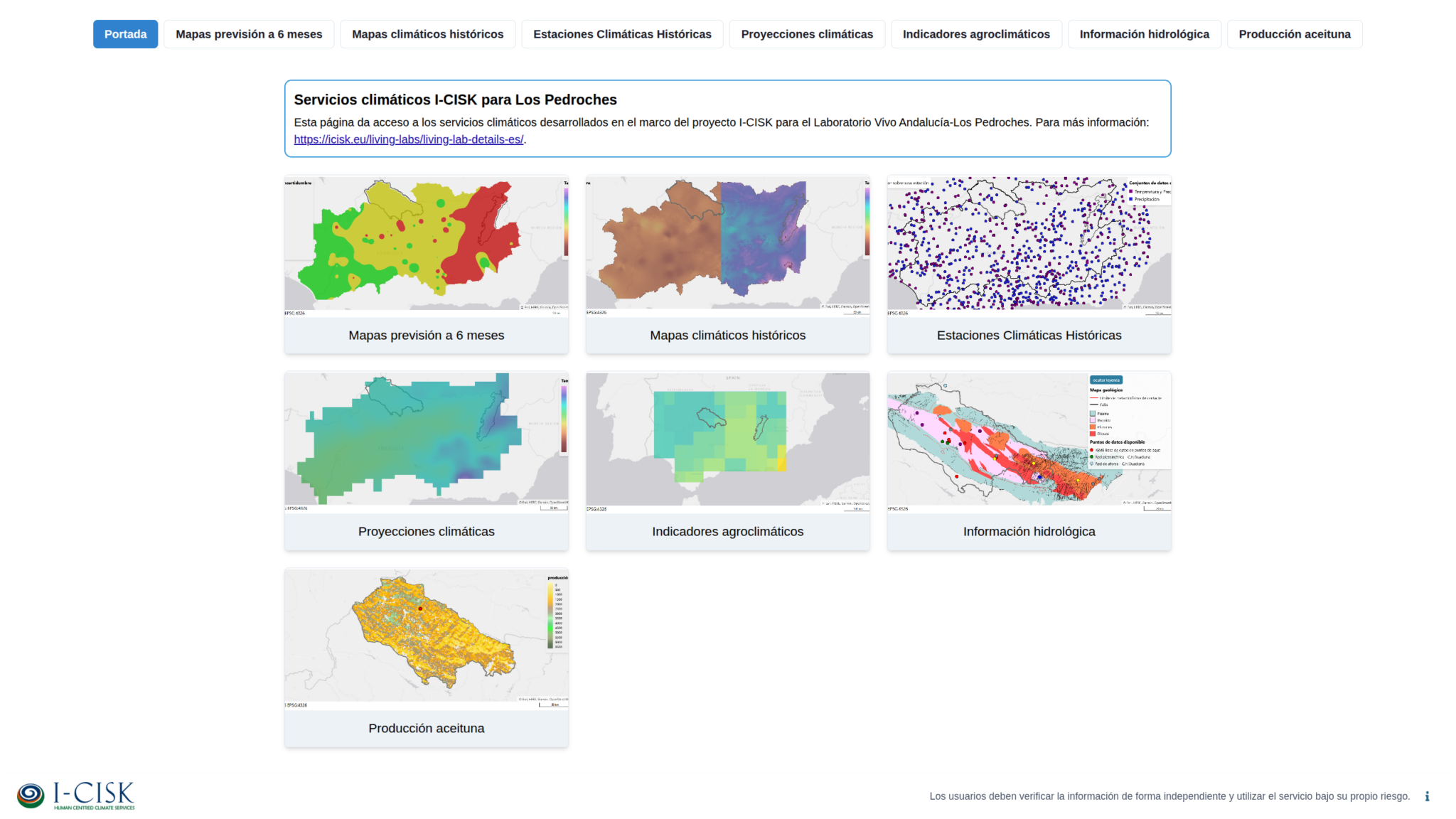
The Spanish LL CS has a clear focus on agriculture in the Andalusia region. The services combine past and recent observations with forecasts ranging from a few months to the year 2040. The data originates from Copernicus and local network operators, but was also specifically collected for the I-CISK project. The historical data helps users understand future forecasts by enabling them to relate predictions to the past. In addition to interactive maps that allow users to compare layers, the services include time series visualizations that can be triggered and plotted for specific locations.
In collaboration with GECOsistema, we integrated different data sources into our backend architecture using OGC API Processes. Our team implemented an automated Climate Service Composer based on a modern Large Language Model AI that enables users to easily create their own CS with their specific data resources. All of our services run on the OpenTelekomCloud (OTC), which is hosted in Europe to ensure data sovereignty.
In addition to these activities, we helped shape the co-design process between developers, climate modelers, and stakeholders. To ensure that the proposed CS fulfill user requirements, we established Climate Service Task Forces within each Living Lab. Comprised of developers, modelers, and a Living Lab host representative, these task forces planned and oversaw development sprints to facilitate productive co-development and guarantee user-centric CS. Our team also participated in discussions and developments regarding how to assess, manage, and present the uncertainties inherent to climate models.
Partners
Coordinator, IHE Delft Institute for Water Education, The Netherlands
European Centre for Medium-Range Weather Forecasts (ECMWF), UK
Swedish Meteorological and Hydrological Institute (SMHI), Sweden
VU Foundation, The Netherlands
CREAF, Spain
Uppsala University, Sweden
The Netherlands Red Cross, The Netherlands
GECOsistema, Italy
Caucasus Environmental NGO Network (CENN), Georgia
Universidad Computense de Madrid, Spain
IDEAS Science Ltd.], Hungary
EMVIS S.A., Greece